Web App · Formula One · 2026
F1 Lab
Speed is a system.
A free, independent Formula One learning and race-reference app - the sport behind the speed. A rotatable 3D car, a strategy calculator, a circuit atlas with pole-to-win history back to 1950, team and driver profiles, and race coverage that refreshes hourly on race weekends. Open it in a browser or install it on a phone; no account, no app store.
11
numbered sections
23
Grand Prix events, 2026 season
1950
circuit history reaches back to
The problem
Formula One is the most engineering-dense sport there is, and the gap between watching it and understanding it is wide. Why one car is quick in Monaco and slow in Monza, why a team pits two laps early, why a pole sitter at one circuit is nearly a lock and at another a coin flip - the answers exist, scattered across technical articles, team sites and decades of results, but nowhere a fan can explore them in one place and come back to every race weekend.
The approach
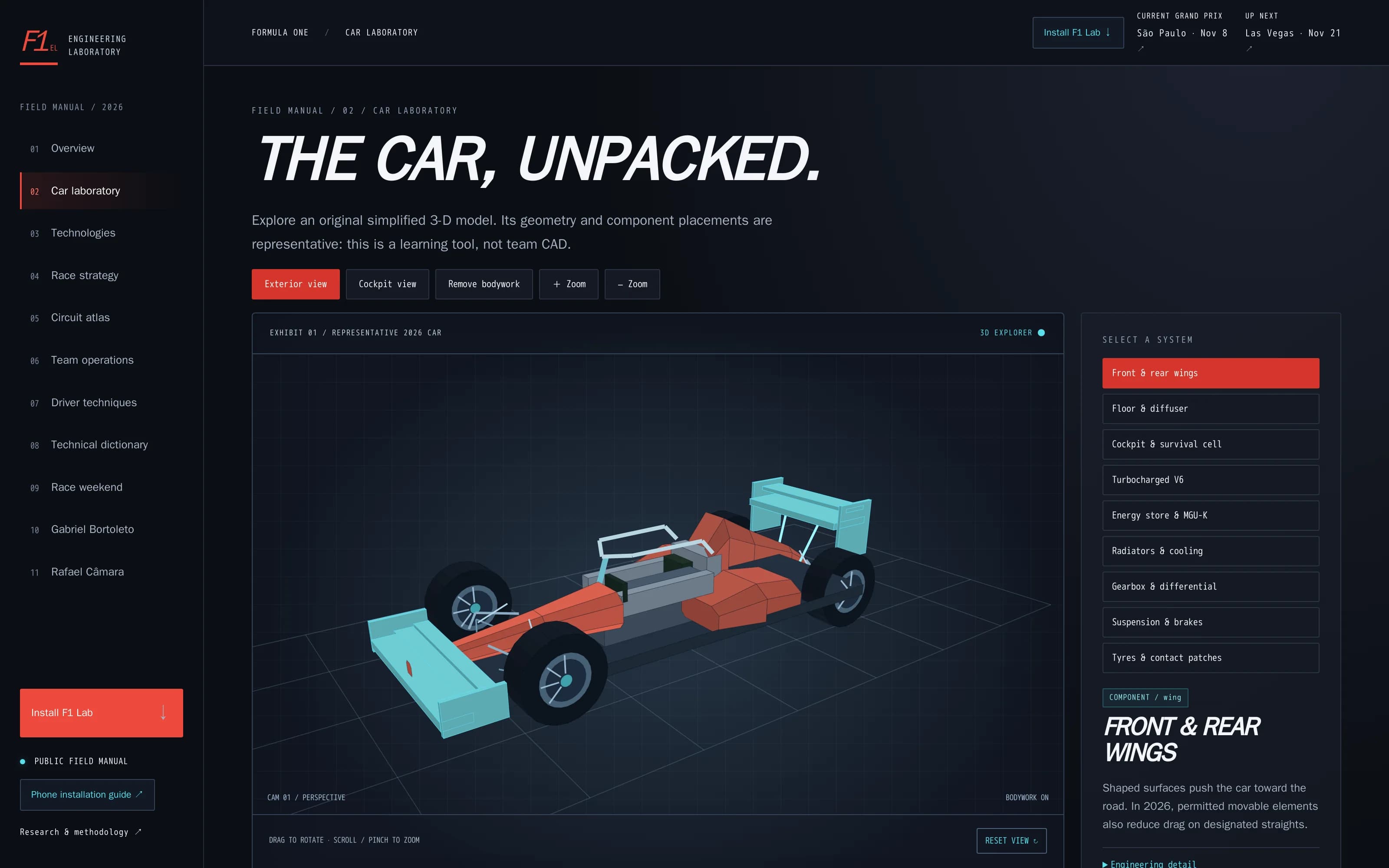
F1 Lab is built as a laboratory and a field manual at once. Eleven numbered sections connect the machine to the people and the decisions: a simplified 3D car you can rotate, open and strip of its bodywork, with every component explained; technology cards that show why improving one characteristic costs you elsewhere; a strategy section with an undercut calculator whose net gain moves as you change tyre advantage, lap gap and traffic cost; a circuit atlas where each venue carries an editorial overtaking score and a pole-to-win record computed from every completed Grand Prix held there, with a season cutoff you can slide; team profiles that separate ownership, governance and day-to-day management; driver-technique pages; a searchable technical dictionary; and a race hub with session results and an editorial Top 5 forecast whose earlier snapshots are kept so you can see how the outlook moved. Two dedicated pages follow the young Brazilian drivers Gabriel Bortoleto and Rafael Câmara through the season. Everything is labeled for what it is: official classification, editorial judgement, estimate or prediction, with sources, dates and sample sizes attached.
Architecture & build
Public reading and private updating are separate services, the same pattern as Musk Drop Daily. The public reader serves the app and an allowlist of data feeds; credentials stay server-side and write methods are rejected. A scheduled refresh runs hourly on Friday, Saturday and Sunday and once a day at 8 AM Eastern the rest of the week, covering race briefings, homepage data, both driver feeds, roster maintenance and circuit statistics; roster changes are checked against official F1, FIA and team announcements, with event-specific replacements kept distinct from permanent ones and effective dates preserved. If a refresh fails, the reader keeps the last good content with its dates and an availability notice rather than going blank. The app is a PWA with a dark laboratory interface: monospaced figures and timestamps, numbered destinations in a persistent sidebar, keyboard controls on the car model, and installation from Chrome or Safari into its own window.
The outcome
Live for the 2026 season with 11 constructors, 22 drivers and 23 events on file. A fan can learn why the car works, test a strategy call, look up a circuit’s history and follow the weekend from one address, with every number traceable to where it came from.
- Sections
- 11, from car laboratory to race weekend
- Coverage
- 2026 season: 11 constructors, 22 drivers, 23 events
- Refresh
- Hourly Fri-Sun · daily 8 AM ET Mon-Thu
- Install
- Android and iPhone, from the browser
An independent fan project, not affiliated with Formula 1, the FIA or any team. Forecasts are editorial; historical percentages describe past samples, not the odds of a future race.